

It’s been many years since I sewed my last quilting cotton garment. When I first started sewing, that’s all I used. Quilting cotton was the most available fabric, and the prints—oh, the prints!!!—were just impossible to resist.
I was on a top-and-skirt kick, and I lost count of how many Tilly and the Buttons Delphines I made. This was before I 1. discovered rayon/viscose and 2. realized that dresses are the best garments if you 2a. have to wake up early in the morning and 2b. live for layers.

Quilting cotton lacks flow and drape, so it is not really conducive to the kinds of dresses I like to sew and wear. All my pretty quilting cottons have been sitting somewhere in the house—stored under my bed, or in the closet, or in my bookshelf cubbies, or inside the living room ottoman, or possibly somewhere in the garage).
Because the power of all this cuteness should be harnessed and turned into, well, cute dresses, I’m on a quest to find patterns that will work well with my quilting cottons. Leave it to Deer and Doe to be the one to lead the charge!
Jump to:
The Pattern


The Sureau Dress by Deer and Doe (Now Closet Core Patterns) is a V-neck dress with a bodice that is shaped by darts and bust gathers, a gathered skirt, and the option to be made sleeveless or with ¾ sleeves. The mock button placket adds interest and complexity to an otherwise simple garment.
Size

The Sureau has yet to have its size range expanded like other Deer & Doe patterns. It goes from a size 34 (B: 33 ¾; W: 24 ¾; H: 45¼) to a size 52 (B: 48; W: 39; H: 59½). My first muslin was a size 46 at the shoulders and upper bust to a 52 for bust and waist but had to expand the top part to a 48 and add some to the side seam at the waist, but I quickly realized that the bodice was going to need a lot of adjusting to fit right (more on this later).
Fabric

The suggested fabrics for this pattern are cotton poplin, chambray, lightweight linen, and seersucker—all with a similar weight to some quilting cottons.
This black-and-white mushroom quilting cotton was purchased from The Sewing Arts Center, the only sewing store in the West Los Angeles area. They primarily work with cotton, with some linen and rayon here and there. The cotton prints are plentiful, in an assortment of colors and motifs that is almost dizzying.
Construction
The Sureau is a very easy sew—if you don’t have to make any adjustments. Right out of the package, this is a weekend project.
But the gods of sewing were not smiling on me (they rarely are when it comes to fitting). It took me four attempts for the bodice and three tries for the skirt to get to where I feel comfortable in this dress.
Bodice
After looking at the measurements for each size, my first bodice was a blend of sizes 46 at the shoulders and upper bust to a size 52 for the bust and 52+ for the waist. It turned out too tight with some major gaping on the neckline.

For my second version, I checked my body measurements against the measurements of the pattern and added where inches were needed. I also moved the bust gathers down to align with my bust apex.
The fit was much better. The bodice did fit well on the shoulders, bust, back, and waist—but I still had a gaping neckline to deal with. The new position of the gathers looked and felt better as they gave my boobs more room.


For my third muslin, I removed a sliver from the neckline and transferred the same amount to the waist dart. Even though the neckline looked slightly better, it still bothered me.
While wearing the muslin, I pulled the excess fabric from where the bottom of the neckline met the top of the placket, held it in place, and looked in the mirror. The gaping at the neckline was almost completely gone! I pinned the excess fabric and marked it with a sharpie. From there, I transferred the changes to the paper pattern and decided that it was a good place to stop.
IMPORTANT: If your bodice has a facing, you must transfer the changes made to the bodice neckline to the neckline of the facing. My preferred method is to simply trace the new neckline and shoulder (if it was not changed when manipulating the neckline) to a piece of paper, and then trace the original bottom of the facing, making sure to smooth any bumps and squaring corners.
Skirt

Gathers are hit-or-miss for me. Some of my favorite garments are gathered skirts, but when it comes to dresses, I avoid gathers in my waist/belly area. I feel they make my apple shape ever more apple-like, and all I can think of is how I resemble a barrel.
I should have trusted what I know about my body and taste and changed the gathers to pleats in the muslin stage. Instead, I sewed the skirt as the pattern instructions intended it to be, gathers and all.
The Sureau has centered gathers in the front—the area where I least need more volume—and back of the skirt. Once the dress was finished, I looked like I was pregnant. Or maybe smuggling a large watermelon into the country.

So I unpicked the skirt from the bodice and moved the gathers from the center to the sides in hopes that that would fix my problem. But—nope. Gathers would not do. So I turned the gathers into simple pleats, and I feel it has been a huge improvement. If you want to learn how to turn your gathers into pleats, I have a tutorial ready for you.
Sleeves

I don’t wear sleeveless dresses. I don’t like 3/4 sleeves. The solution? I simply shortened the sleeve pattern piece! This is a super easy way to change the look of a garment.
Side Zipper

For the side zipper, I left the side seam open and used an invisible zipper. I’ve decided that closing my zipper without the danger of breaking its pull is more important than having a very invisible zipper. I’d rather see the tape peak a little than having to replace it when it invariably breaks.
Seam Finishes and Hem
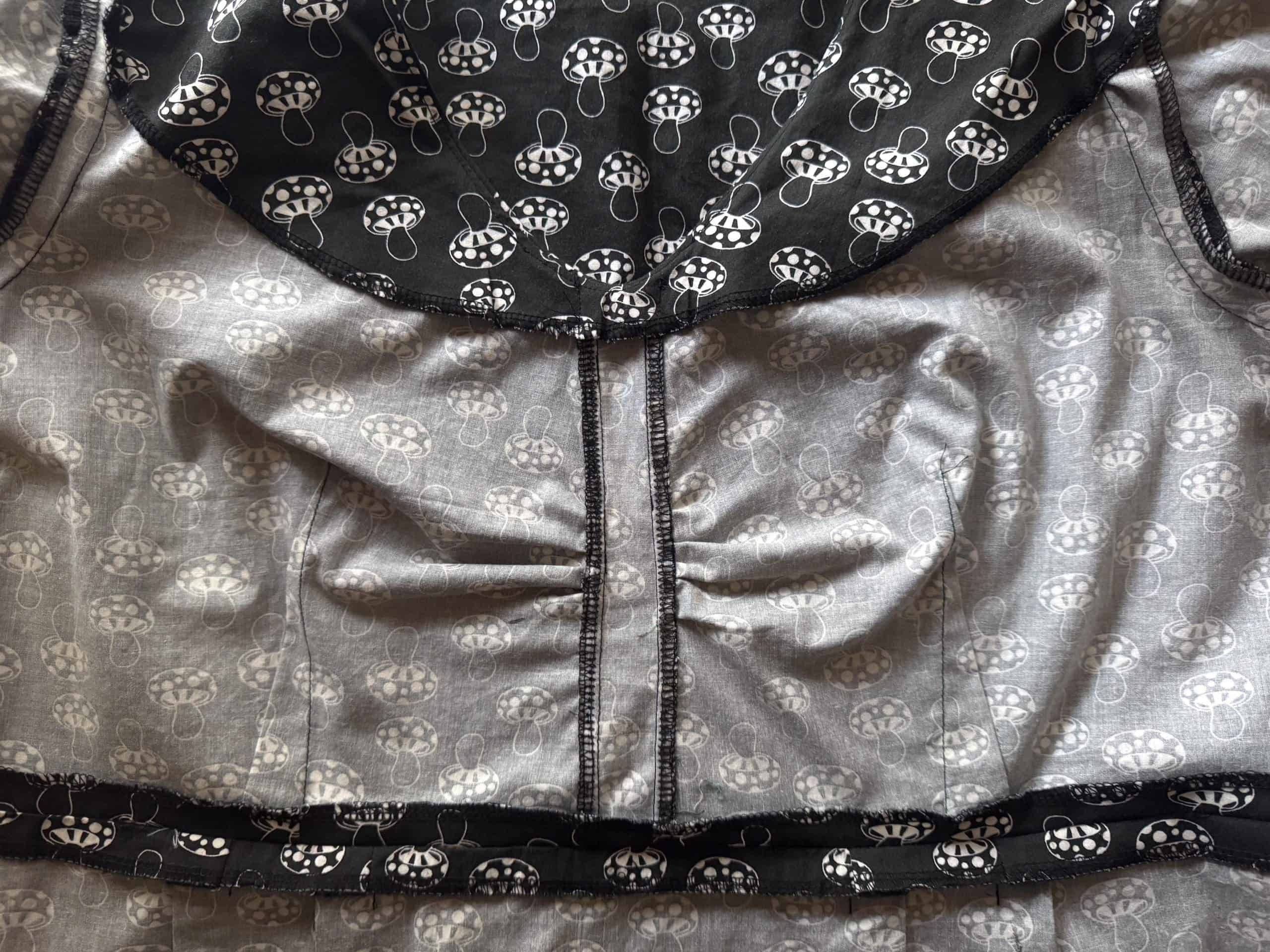

All raw edges were serged before I sewed the dress—with the exception of the neckline and the top of the facing. I knew I was going to grade that seam, so why waste time and thread?
The hem was handsewn. You can use your sewing machine here, but I really enjoy the extra touch that an invisible hem gives. I press a ¼” or ½” in from the hem, and then I press my desired hem depth (usually 1”). To make the stitches almost invisible from the outside, I use a blind stitch with a thread the same color as the fabric. All you can see—if you see anything—are tiny stitches at regular intervals. I think it looks lovely!
The Sureau


I don’t know if I love this version of the Sureau. The fabric that I used was on the stiffer spectrum of quilting cotton, and the dress has a bit more structure than what I was expecting. That is not to say it is a failed experiment—the mushrooms are adorable, and maybe after a washes, the fabric will become more pliable.
The best part of this whole process is that now I have a pattern with all the fitting adjustments made. I am already working on a black rayon version (I’m back in black rayon!), and I have other cotton fabrics that are more garment-friendly. I’ll keep you all posted on how these go.

